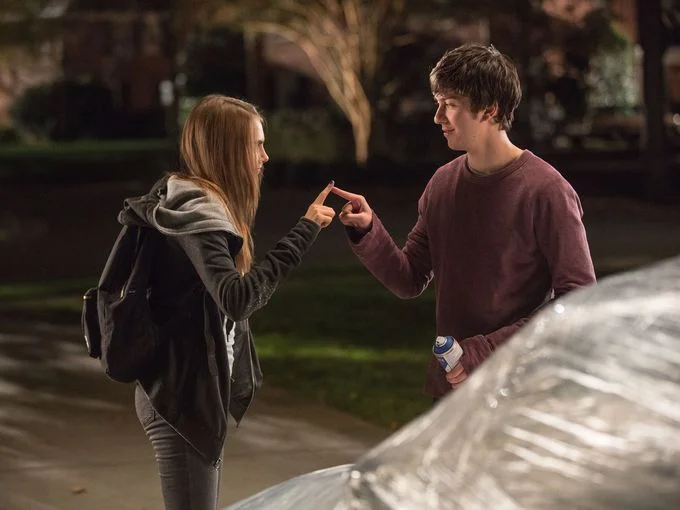
Aided with the clues Margo left behind, he sets out on an cross-country adventure with his best friends, Ben (Austin Abrams) and Radar (Justice Smith), traveling 1200-miles to upstate new york to find Margo and her new, fictional place of residence, risking the possibility of missing prom.
Prom? What started out as a promising tale of self-discovery disappointed me when they made the stakes so mundanely low, ultimately condemning Paper Towns to be a typical teen flick. It contains all the elements of an average teen movie: Kids sneaking out, cool kids conspiring with nerds, a complete lack of adult supervision, a wild party, and, of course, a Senior Prom in jeopardy. With the only real risk being the possibility of missing prom as opposed to graduation itself as it was in the original text, screenplay adaptors Scott Neustadter and Michael H. Weber did not give Paper Towns much room to grow.
Another example of exaggerated low-stakes is the overly dramatic scene during the road trip at the gas station. With only six minutes to fill the car with gas, buy some food and grab a change of clothes, the trio of teens, now joined by Radar’s girlfriend Angela (Jaz Sinclair) and Margo’s best friend Lacey (Halston Sage), sprint out the convenience store and pile into the car with Quentin doing a cute little spin over the hood. I understand the need to represent a time crunch, but the scene comes off as being overemphasized.
Though not solely the fault of Shreier who does try to take advantage of slower scenes in between for character development, the cast still feels paper-thin. Quentin starts out as a work-obsessed geek who is loyal to rules and restrictions and ends the movie with hope for the future, marveling in the revelation that Margo was never more than a girl (“What a treacherous thing it is to believe a person is more than a person”). This is a revelation he would not have come to terms with if not for Manic Pixie Dream Girl, Margo Roth Spiegelman.
According to film critic Nathan Rabin, a Manic Pixie Dream Girl (MPDG) is a cute and quirky, female romantic lead “that exists solely in the fevered imaginations of sensitive writer-directors to teach broodingly soulful young men to embrace life and its infinite mysteries and adventures.” Here lies the neat and tidy description of Margo’s role in Paper Towns. The problem with characters like Margo is that she only exists as a means to aid the young white male on his own road to discovery. Paper Towns’ story arc inched along until it eventually dropped off at the discovery of Margo, and seeing as we never find out what she intends to do with her life (let alone where she lives), one can’t help but feel the filmmakers simply used the trope of a confused young girl as an easy plot-device. But hey, as Margo said, “Everything is uglier up close.”
One can appreciate Paper Towns with nostalgia for high school days, but with that being said, I would have enjoyed the film a lot more if I was still fifteen years old. By leaving out so much of the novel, Shreier’s adaptation failed to fully realize the inspiring, coming-of-age story John Green had mapped out.