
TRANSVERSO

- A culture magazine reaching terminal verbosity -

Julien Baker's Debut 'Sprained Ankle' Is Painfully Good

Music ReviewSean McHughComment

The world of music adores artists that are seemingly beyond their years – Låpsley, SOAK, Lorde – each has their own unique appeal. But none of those artists have managed to create intimately visceral narratives to the point of worry that Julien Baker has crafted on Sprained Ankle.

Sprained Ankle marks Baker’s official debut release on 6131 Records, an effort that reveals the nineteen year-old Memphis native’s matter of fact assertions of wishing “I could write songs about anything other than death.” A slightly alarming statement coming from someone of her age, Baker weaves private thoughts into vividly bleak accounts of nurses administering sedatives and awaiting the subsequent unconsciousness on “Brittle Bones.” Including lines like “I’m so good at hurting myself,” it begins to paint a perspective of Baker’s intense awareness of the frailty of life.

Tender and inward, Baker’s earnest soprano floats above guitar loops that at certain points actually resemble heartbeats over a rhythm base. Songs like “Good News” really start to give the most barren look into Baker’s psyche: “I know its not important / But it is to me / And I’m only ever screaming at myself in public.” She offers up her startling self-awareness in a poignant manner, and while for others such honesty might be be exultant, for Baker it's unexpected to the point it could frighten some. But that’s the beauty of this record; such fragile narratives offered up by someone so unassuming allows her lyricism to cut to the marrow of anyone listening.

Sprained Ankle ends on a somber note, with a song about addiction (of whose its hard to tell) in “Rejoice,” that offers thinly veiled anger like “Call the blue lights / Curse your name,” and uncertainty, “I think there’s a god / I think he hears either way.” Baker’s detached vocals create an intense empathetic aspect to the track and album as a whole. The album ends with the aptly named “Go Home,” which presents Baker at her least self-conscious yet most apologetic with “Burned out on the edge of the highway / I’m sorry for asking please come take me home.” Being so young and so incredibly mindful of the personal nature of the album, “Go Home” acts as a firm completion of this harrowing announcement of her existence, an end to the first installment of Baker’s emotional outpouring, and a return to solace until the next cathartic release.

Baker’s songwriting is peculiar in the fact that it acts as a sort of a misdirect. Without taking much consideration of the songs, one might assume Baker has an oddly morose outlook on life, with so much focus on the desolate motifs and dying nature of life, however, it should be argued, it actually acts as a foil to that thought. Sprained Ankle presents the unnerving realities of life in an ambient sense, as a sort of celebration of living and having the awareness of knowing this could be the only chance to do so. In turn, it creates one of the most powerful debut records of 2015, and likely the inception of a more fertile and durable career than that of Baker’s counterparts.

EXCLUSIVE PREMIERE: Explore the Dark Side of Veneto in Zebra's "Blanco" Video

Exclusive Premiere, New MusicWeston PaganoComment

Venice-based trio Zebra have premiered a beautiful new music video to accompany "Blanco," the single from their debut EP Homo Habilis released late last year.

Opening with a steady firecracker of driving percussion the track then layers on some gentle harmonizations before delving into crunching guitar jabs as the lens flares over an odd dream sequence of events shot across Italy's Veneto region. Flirting with some math rock and grunge elements, Zebra prove sometimes the most dynamic developments in independent music don't always come from the most predictable of places.

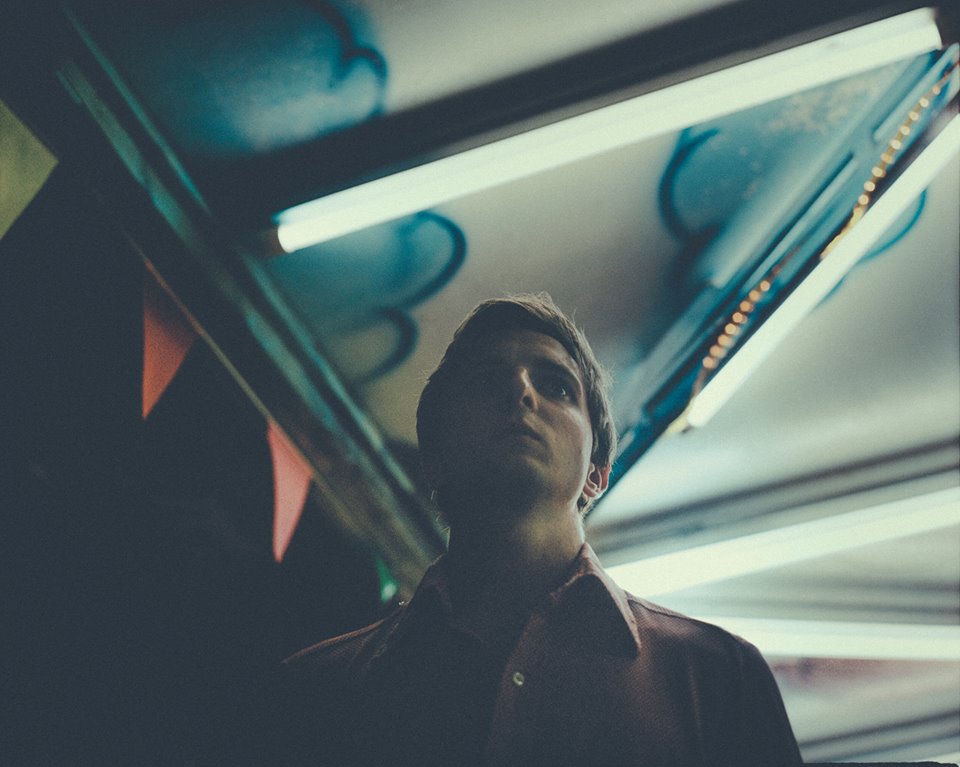
The video itself, directed by Italian cinematographer Andrea Calvetti, was shot entirely on 16mm film with only available light and two neon bars. Combining a series of seemingly disjointed experiences from a lonely fairground jaunt to an eerie cave with strange inhabitants, the visuals form a captivating story companion to frontman Luca Zambelli's longing to "Turn this gray into gold."

Zambelli told Transverso,

The video portrays our character as artists, emptied from creativity and lost in a world where time has no dimensionality, a world of passion and art, but also futility and melancholy.

Check it out below.

You can buy Homo Habilis here.

Find Company in Majical Cloudz's Crippling and Cathartic 'Are You Alone?'

Music ReviewWeston PaganoComment

You can sense the music that Majical Cloudz creates staring into your soul the same way you feel Devon Welsh’s unblinking eyes piercing and stitching you up all at once. The sound of Majical Cloudz is bathing in that small, warm patch of light streaming into an otherwise dark room. There are icicles on the mantel.

Are You Alone? takes off where the Montreal duo’s preceding Impersonator left off; a paradox of bare-bones, minimalist soundscapes ebbing with lush depth that are somehow simultaneously tranquilizing and uplifting. Welsh’s immaculately vulnerable monologues and unflinching vocals are gently bold, and they drive their synth lullabies forward with severe care. Calculatedly organic, passionately controlled, it’s a journal reading in a dream.

Not much has changed in that regard; it’s still quintessentially Majical Cloudz. If anything, this new record has shrunk the band’s dynamism to an even narrower midrange. Gone are the pitter patterings of “Mister” and the thick locomotion of “Childhood’s End.” Even the already opaque and pale cover art of it’s predecessor is scaled back to a purer incarnation sans artist name. It’s austerity at its most suffocating.

"Will you let me change? / I want to but I think you want me the same,” Welsh asks on “Control.” And it’s a fair assumption. While there is certainly little evolution here, who can complain when the niche carved out is so compelling and captivating even at it’s most static? Majical Cloudz may need to diversify at some point in the future to keep the fast-paced music world interested, but that time is unimaginable as of today. In “Heavy,” he concludes with calligraphic repetition, "You gotta learn to love me / Cause I am what I am.” 

And what is he? Undoubtedly an acquired taste for some, yet his lyrical content is not that far removed from the pop platitudes of Top 40 with lines like, "And we're going downtown / Cause we feel like running around / Is it really this fun when you're on my mind? / Is it really this cool to be in your life?” in lovely standout “Downtown.” The uniqueness in Welsh’s artistry is not necessarily every sentiment in itself, but the crushing sincerity and earnestness in which they are mined and delivered.

Welsh's simplicity is always innate and genuine, never formulaic. It’s as if his words are leaking out of a very well-produced private tape recorder one’s stumbled upon in the night. Though Are You Alone? as a whole is an offer of companionship, there is still a sense of shouting into the void as the title track implores, "What's the point of a sad, sad song / Do You hear what I'm saying / Or not at all?" 

There is at least one change since Impersonator, however, and that is somewhat of an upward emotional turn. While the previous record is near end-to-end misery, Are You Alone? often transitions into glimpses of sanguine, childlike wonder. "And if suddenly I die / I hope they will say / That he was obsessed and it was okay,” he admits. His obsession is crippling and cathartic and carries over to the listener by IV.

The first time I heard leading single “Silver Car Crash” I was strapped to a Boeing in the process of taking off. What ensued was a fitting 4D experience, literally soaring along with the track’s whirring body and Smiths-esque, morbid confessions of adoration. As the pressure pushed me back down into the seat to spite the adrenaline I wondered how much of it was my own inertia and how much of it was Welsh himself, slowly constricting around me. I hoped my vessel would fare better than his own vehicle's violent end.

"And I know love is worth it / I am in perfect love with you / But I am dead already / And I am bleeding onto you / I hope you won't forget me / I am so hopelessly for you" he asserts in his final breath. It's Welsh at his most overbearing, and yet his tight grip is irresistible. Unlike "Bugs Don't Buzz," Are You Alone? might just end with a smile, even if it's a crooked one softly broken on the dashboard.

'I Thought the Future Would Be Cooler' Is YACHT's Post-Modern Manifesto

Music ReviewSean McHughComment

As we’ve all been reminded to the point of mind numbing redundancy, October 21, 2015 marks the exact day Marty McFly traveled in time to a future filled with hover-boards, Jaws 19, and Mr. Fusion. In short, none of those hare-brained ideas have come to fruition, leaving many pop culture enthusiasts yearning for a “future” that would have been much, much cooler.

YACHT front woman and self-professed futurist Claire L. Evans may or may not share the same personal sentiments as many pop culture devotees, but YACHT’s sixth studio album, I Thought the Future Would Be Cooler, does not hold such convictions. Instead, the album addresses the bothersome nature of today’s “future” is in fact much more woeful than imagined.

YACHT has been known for variably high concept albums in the past, but ITTFWBC reaches new grounds. In promoting the album’s release, Evans and Jona Bechtholt chose to release a lyric video for “L.A Plays Itself” that certainly challenged the norms for album promotion. The video can be found on a specific domain of the same name, however there is an intriguing twist, the video only plays when Los Angeles Ubers reach surge pricing. Intended to highlight the growing traffic problem in Los Angeles, the intention is admirable, but might risk being too novel in premise. 

Some of ITTFWBC’s track titles alone indicate that Evans and Bechtholt are taking direct issue with society’s “plugged in” disposition. “Ringtone” takes jabs at our attachment to cell phones and the subsequent detached nature of modern human interaction with “hold me up to your face/hold me close to your ear/ hold me close to your head/I’m on the line why aren’t you here?” A playful package for a more critical narrative, something Evans’ deft writing lends itself to wonderfully. That being said, certain songs like “Don’t Be Rude” toe the line of heavy-handed attempts at getting a point across and subtle suggestion. Despite that fact, the musicality of the album is powerful and propels the listener to soldier on. Unfortunately, Bechtholt’s beats and funk infusion may be too infectious.

ITTFWBC is a premier platform for Evans and Bechtholt to opine over the present state of societal affairs, cultural cornerstones of the YACHT manifesto. Each track serves as its own individual touchstone within the larger demonstration of technological aversion, with a sonically self-aware wink to the highly electro-nature of the album. Irresistible tempos and pulsing beats make ITTFWBC hold the listener’s attention to the point of potential distraction, which really muddles the lyrical content of the record.

High in concept, the album’s true intention is almost certain to be obscured by the sensationalist song titles like “I Wanna Fuck You Til I’m Dead,” and “War On Women,” catchy cadences, and sing along choruses, but to the listeners who are able to see through the heavy handed use of smoke and mirrors, they will truly understand the record, and YACHT will certainly be satisfied.

Beach House Make Small but Meaningful Changes on 'Thank Your Lucky Stars'

Music ReviewSean McHughComment

Plenty of landmark events have happened in the two-month span between August and October of 2015. Facebook announced their intent to roll out a “dislike” button, and social curmudgeons everywhere rejoice. Summer sports aficionados sat on the edge of their seats as the Minnesota Lynx capped off the 2015 WNBA (Women’s National Basketball Association) season with a championship. And most unfortunately, Donald Trump is still spewing asinine commentary along the campaign trail.

Pop culture potpourri aside, there may be no other event more uncharacteristically monumental than Beach House’s two album releases in as many months’ time. The dream-state, shoe-gazing nature of the Baltimore duo works wonderfully for the multiple year breaks in the band’s discography, with more than three years passing between Beach House’s Bloom beauty in 2012 and this past August’s Depression Cherry LP. So when Beach House announced the release of their second 2015 record, Thank Your Lucky Stars, for October 16, 2015, the indie world let out an exuberantly passive huzzah.

After the predictable (though enjoyable) sameness that was Depression Cherry, Victoria Legrand and Alex Scally’s assurance that TYLS was a departure from the typical Beach House approach seemed to enliven many that this may in fact be the band’s best work yet. That “departure” may have been a bit of a misnomer in regard to most people’s assumption that “departure” in fact equals “different,” when in fact, that was not the case. The press release explains:

Thank Your Lucky Stars was written after Depression Cherry from July 2014 - November 2014 and recorded during the same session as Depression Cherry. The songs came together very quickly and were driven by the lyrics and the narrative. In this way, the record feels very new for us, and a great departure from our last few records. Thematically, this record often feels political. It’s hard to put it into words, but something about the record made us want to release it without the normal ‘campaign.’ We wanted it to simply enter the world and exist.

Despite the ample explanations that accompany the record’s release, TYLS is still an enigma. The band’s insistence that it isn’t a Depression Cherry companion becomes difficult to grasp on tracks like “Majorette” and “She’s So Lovely,” with both tracks moving in broad strokes that resemble both Depression Cherry and Teen Dream. The “classic” Beach House metronomic sound echoes in the background of virtually every song.

That being said, there are songs on TYLS that act as the enviable marriage of the albums ultra-lo-fi beginnings and more recent endeavors, such as “Elegy to the Void.” Perhaps one of the best integration of all five preceding albums, you hear the metronome, drums are crisper, individual instruments are audible, and Legrand’s lyrics are unexpectedly discernible at certain points. Other songs avoid becoming heavy handed shoe-gaze with tired pop banality, such as “Common Girl” which seems to focus on one central, wretched character: “She makes movies where she cries on cue / She still lives downtown…” and “Takes the pills and hides the notices / Cartoon rings of ill will.” TYLS is miles away from tropisms like “I’ll take care of you…”

All in all, Thank Your Lucky Stars acts as an extension of Depression Cherry in a lot of ways, as well as pivot point for Beach House’s career as a whole – many may want the band to actively change in a progressive way but the band chooses to continually broaden their sound in the most familiar and microscopic ways possible instead. It's what works for Legrand and Scally, and its afforded Beach House the ability to carve out a dream-pop legacy (and avoid becoming a caricature) on their own terms.

Drug War Epic 'Sicario' Is Gripping and Intense Filmmaking

TV/Film ReviewEthan WilliamsComment

Since making the translation to English-language films, director Denis Villeneuve dropped one of the most viscerally gripping crime films of the past few years with Prisoners and one of the most thought-provoking thrillers starring a Hollywood actor with Enemy. And with his latest, Sicario, Villeneuve brings his excellent grasp of cerebral tension to a very timely drama about the Mexican Drug War. Reuniting with the incomparable Roger Deakins as his cinematographer, Villeneuve tries to dig deep into a struggle that has defined a region for decades now.

Sicario manages a very rare thing in Hollywood in that it happens to be a movie completely of its time. The conflict being portrayed is still very much happening and is still taking lives on both sides of the border. Even though most Americans aren't truly aware of the day-to-day skirmishes, the cartels and the agencies of both governments are still fighting for control.

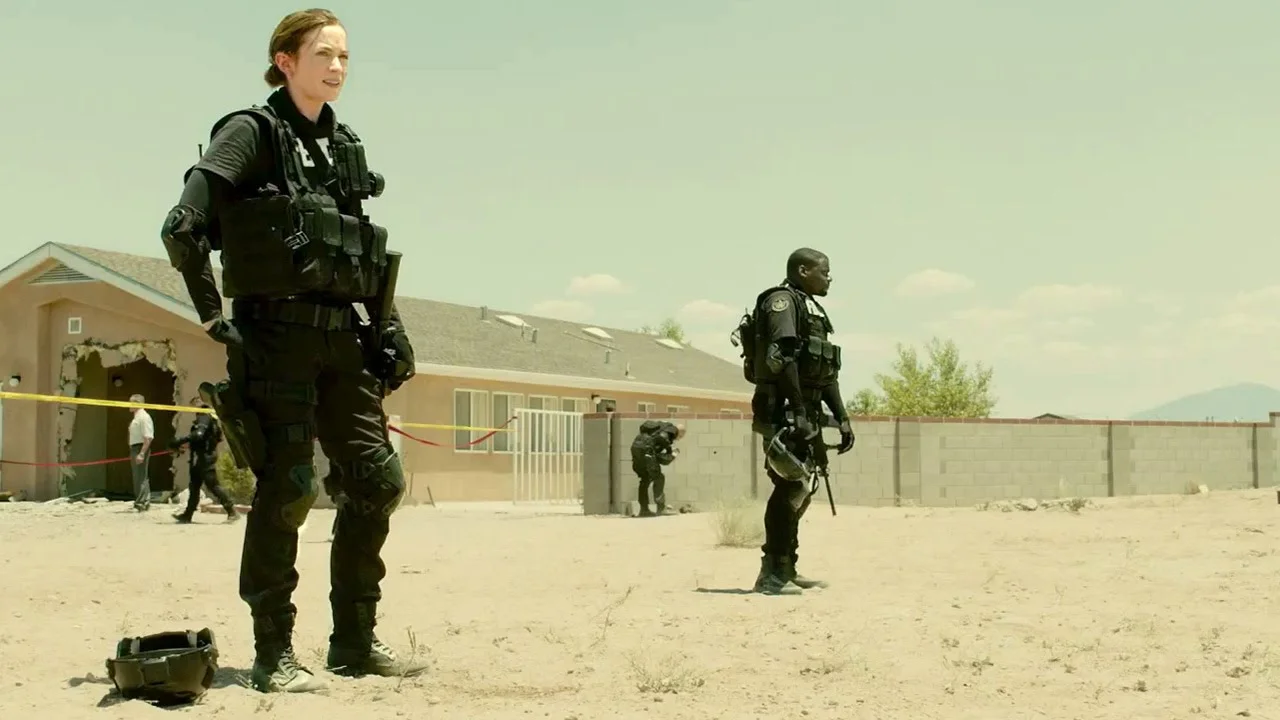
Our window as an audience into this frankly terrifying new world is Special Agent Kate Macer (Emily Blunt), newly assigned to a Department of Defense task force to take down some high-level cartel members. But the more she works towards making things right the more she begins to realize that she may be in over her head and nothing is as black and white as she thought.

But if Kate is our protagonist and supposed to be the audience's viewpoint into this unfamiliar world, she is interestingly kept at arm's length from most of the film's action. She is always shown to be at a distance or just out of earshot when her superiors are discussing operations or explaining tactics. Therefore she's kept in the dark and so are we as viewers. It’s more than a little intimidating for both audience and character because if we are kept in the dark, that means we have no idea of the potential danger that lies ahead.

This is the film's way of carefully doling out information piece by piece, and the more that Kate tries to pry into what’s really happening, the more horrified she is to learn of the implications of it all. Josh Brolin plays up his bravado as the DoD man Matt Graver who reluctantly yet unabashedly reveals to Kate and the audience that their view of morality is simply nonexistent in this underworld. And that gray morality comes into full view with Benicio del Toro’s Alejandro Gillick, in a role that has to be a frontrunner for this year’s Best Supporting Actor Oscar. Del Toro is mysteriously aloof for the first hour in the middle of so much mayhem but as the action escalates his portrayal of menace and determination was an absolute revelation.

Boasting setpiece after intense setpiece, the realizations come very slowly and the tension builds to a fever pitch with another wallop of an ending from Villeneuve. It will have you gripping your seat from start to fantastic finish.

But the most important thing is the film doesn't offer any easy answers because there simply aren't any. Morality is a mess of grays; "good guys" and "bad guys" simply don't exist in this universe. Families are torn apart every day by this drug war, and Sicario acknowledges that we are near helpless to stop it as innocent bystanders, as the gut-punch ending makes very clear.

Boosted by a tight script from Taylor Sheridan, a searingly intense score from composer Jóhann Jóhannsson, some absolutely beautiful shots from Roger Deakins(the shot where the assault team disappears under the Mexican horizon as if they are descending into hell is one of the year’s best) and some truly Oscar-worthy performances especially from Benicio del Toro, Sicario is yet another overwhelming experience from Denis Villeneuve and one of the year’s must-see films.

Majical Cloudz Release New Music Video "Downtown," Announce Tour

New Music, Music NewsWeston PaganoComment

Following the music video for "Silver Car Crash," minimalist emoters Majical Cloudz have released a similarly DIY, black and white music video for the new second single from forthcoming sophomore album Are You Alone?, "Downtown."

The playful home video-esque production and the unusually optimistic nature of the track itself ("Is it really this fun when you're on my mind? / Is it really this cool to be in your life?") is in stark contrast to much of the Montreal duo's previous discography, though the gorgeous depth of synth and simple yet beyond powerful vocal deliveries that they've come to be known for are still there, if not even stronger than before.

Oh, and we finally get to see him blink, even if only briefly, around the 2:09 mark.

Are You Alone? comes out next Friday via Matador, and it can't come soon enough. Watch "Downtown" and check out the new tour dates below.

Majical Cloudz Tour Dates

10/17 – Toronto, ON @ Smiling Buddha
10/21 – Brooklyn, NY @ National Sawdust
10/22 – Halifax, NS @ Halifax Pop Explosion
10/23 – Montreal, QC @ Phi Centre
11/07 – Middlebury, VT @ Middlebury College
11/18 – London, UK @ St. John on Bethnal Green
11/20 – Paris, FR @ L’Archipel
11/23 – Brussels, BE @ Botanique Rotonde
11/25 – Berlin, DE @ ACUD
01/15 – Toronto, ON @ The Garrison
01/16 – Detroit, MI @ TBA
01/18 – Chicago, IL @ Schubas Tavern
01/22 – Vancouver, BC @ Cobalt
01/23 – Seattle, WA @ TBA
01/24 – Portland, OR @ Mississippi Studios
01/26 – San Francisco, CA @ The Chapel
01/29 – Los Angeles, CA @ TBA

"The Knower" Is Elderly Arsonist in New Youth Lagoon Music Video

New MusicSean McHughComment

In what has become a growing string of ocularly stimulating and thematically fascinating visual companions for Youth Lagoon’s recent Savage Hills Ballroom LP, Trevor Powers has now followed up "Highway Patrol Stun Gun" with a new, Lucas Navarro-directed video for “The Knower."

The video follows a mystifying old woman wandering about what looks to be an animated nursing home filled with vibrant adornment that serve as purposeful symbolism or deliberate misdirect.

The video scans various parts of nursing home life– a bingo hall, a solarium walkway, someone’s hand sliding off of a cane – that eventually leads to the illumination of the building’s name as the “Savage Hills Retirement Home.” Could this video provide context to the origin Trevor Powers’ choice of album title?

More setting passes and then we’re met with the tired eyes of an elderly woman, meandering across a swimming pool deck, in total and complete solitude. Another shot of the cockatoo and then a match igniting into flame, and all of a sudden, the Savage Hills Retirement Home ballroom is set ablaze as the elderly woman turned arsonist watches in quiet tranquility.

The silent, lifeless shots seen at the beginning of the video are now disrupted with fits of flame and frenzy, when all the while, our favorite elderly arsonist ambles out of the ballroom with only the slightest sense of urgency. Amidst the tumult of the inferno, the cockatoo breaks out of its cage, perhaps symbolizing Powers’ coming to grips with the death of a friend, or maybe even utilizing the allegorical connection of a cockatoo being a sign of spiritual providence. Who knows?

Our favorite elderly arsonist is last seen dancing amongst the flames of the Savage Hills Retirement Home ballroom, with the cockatoo flying past in escape. “The Knower” certainly offers up some powerful imagery in its visual counterpart, but Powers’ true intention behind the video is shrouded I the same stimulating imagery, which makes the experience all the more lush.

Savage HIlls Ballroom is out now via Fat Possum Records

'The Martian': NASA’s Kickstarter Trailer

TV/Film ReviewDanny BittmanComment

When you watch movies like Apollo 13, Lincoln, Argo, or any other movie based on a real event, you always end up thinking, “It’s pretty amazing that this actually happened.” Stories carry a grander emotional weight when you become aware that they’re a part of your own history. But as I watched Ridley Scott’s, The Martian -- a movie about a stranded astronaut who attempts to survive on Mars -- I had to repeatedly remind myself that this story is fictitious.

Thanks to the source novel by Andy Weir, the attention to accurate problem solving alone will have you feeling like you could survive on a foreign planet. But on a emotional level, Ridley Scott’s ensemble directing makes this story not just about isolation, but really a collective of humans working together to achieve impossible tasks. It’s a clear and bright vision of what our space program can become, provided that we continue to fund it. A depressing thought when you consider that we’ve only sent robots to the red planet.

While I enjoyed the emotional pacing of the piece, I thought the filmmakers could have done more with the Martian planet itself. Mars is a place that used to be flooded with water, and might have even harbored organic life. But now it’s clutching to the last of its atmosphere, as if someone left it behind like the stranded astronaut, Mark Watney (Matt Damon). The mix of practical and special effects to simulate Mars makes you feel as if you are there, but the editing during the scenic shots is too quick. The audience isn’t allowed enough time to let their eyes wander in a shot.

The story jumps through Sols (a day on Mars) fairly quickly too, so the pressure of Watney’s time in isolation is minimized. I think by extending these scenic shots, the audience would have more time to stare off into the Martian horizon and think about the planet, exactly as Watney does every Sol to plan his survival. Overall the editing was well executed, it’s just at certain points the planet feels more like a prop than an actual location where Watney is stuck.

I’ve seen this type of rushed editing a lot in recent sci-fi flicks, most popularly in Christopher Nolan’s Interstellar. Every time they show a shot of Saturn, or any kind of space scenic, they cut to something else. It makes me long for the editing style in Stanley Kubrick’s 2001: A Space Odyssey, or the opening shots in The Coen Brother’s No Country For Old Men. I understand the need to keep the runtime low, but adding two minutes of Mars scenic shots would have done the trick. There actually could be an interesting way to link virtual reality (VR) headsets, and movies here. Imagine that every time the movie stops to show you a scenic shot of Mars, you could wander the planet in VR, as if you’re Mark Watney, and this is your free time to explore.

For a survival story that manages to stay light-hearted, Watney's ultimate fate is never made too obvious, which makes the movie extremely enjoyable to watch. The experience is similar to watching Apollo 13 as a kid before any one told you about the outcome of the mission. So go see it, or instead donate your $14 to NASA so you can see Mars with your own eyes in this lifetime. Either way, this movie will inspire you to become a fan of supporting the U.S. space program. #NASAKickstarter