TRANSVERSO

- A culture magazine reaching terminal verbosity -

'Mission: Impossible - Rogue Nation' Continues Series' Incredible Resurgence

TV/Film ReviewEthan WilliamsComment

If there’s one thing that Mission Impossible: Ghost Protocol proved, it was that it’s never too late to inject some life into your Hollywood franchise even with three installments already on the books. While the adventures of IMF agent Ethan Hunt had always been loads of fun, it was Brad Bird’s absolute joyride that was the first to make the jump from good to great. And if there’s one thing that Mission Impossible: Rogue Nation could be faulted for is that it does feel quite similar to its wildly successful predecessor.

The thing always most striking to me about the Mission: Impossible franchise was its ability to have remarkably different visual and narrative styles but still retain enough similarities to make the series feel coherent. Each new Mission was an experiment in how a new director could infuse their unique visual style with Tom Cruise’s love of practical stunts and decadent spy setpieces (a concept explored in this wonderful video essay by Sean Witzke) And while writer/director Christopher McQuarrie may not continue this sort of radical visual experimentation, Rogue Nation still offers plenty of fun allusions to film history and plenty of incredible action sequences that are among the high points of the entire series.

Rogue Nation finds the invincible Ethan Hunt on the trail of a vague network of underground terrorists known as “The Syndicate,” a group using the same amount of stealth and skill as the IMF but instead using it to spread chaos. At its head is the mysterious Solomon Lane, played with hissing menace by Sean Harris in the best villainous role of the series since Philip Seymour Hoffman’s terrifying turn in the third Mission. So to combat that threat, Hunt has to reunite the old team once again, including the hysterical Simon Pegg as Benji (finally given plenty to do in Rogue Nation, his third outing), as well as Ving Rhames’ Luther and Jeremy Renner’s Brandt.

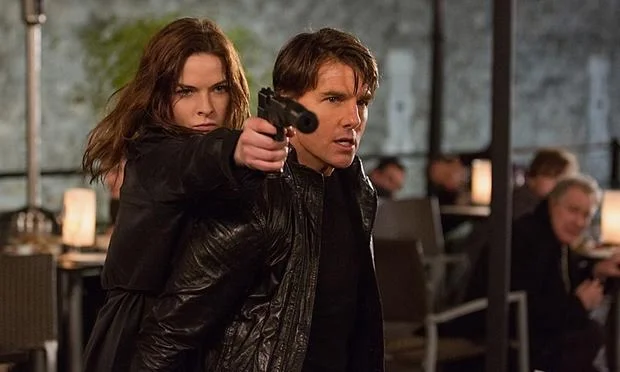
As fun as it is to see the old faces again, the real star here is the new arrival of Rebecca Ferguson, who plays the illusive Ilsa Faust, a seemingly rogue MI6 agent practiced at the art of deception. In a refreshing change of pace from many modern roles for women in action blockbusters, Faust is given free reign to be interesting, layered and, above all, kickass. Sexy but never defined by her sexuality, the movie takes the time to let her develop nuance and make a memorable addition to Ethan Hunt’s accomplices he’s acquired over the years. (And, as an aside, having her named Ilsa and placing the action in Casablanca is a reference too lovely not to grin at.)   
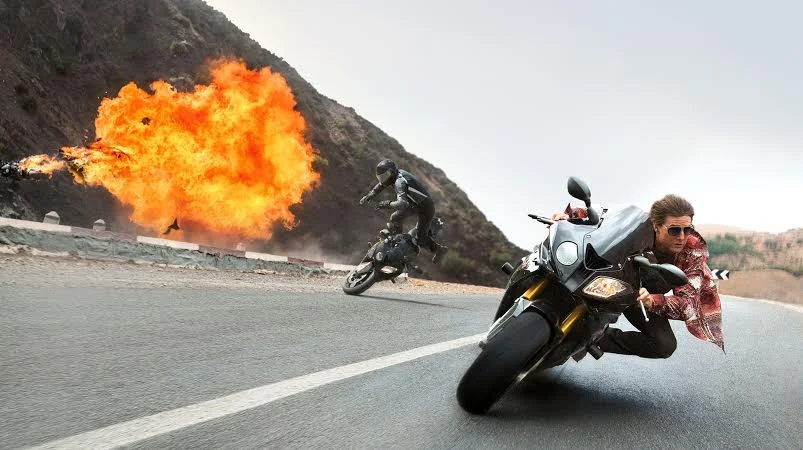
Just as important as the team in a Mission: Impossible movie is the increasingly madcap action sequences Ethan Hunt has to put himself through, and thankfully Rogue Nation doesn’t disappoint. From the get-go Cruise is hanging off the side of a giant cargo plane 5,000 feet in the air, and it’s clear that neither he nor McQuarrie are interested at all in scaling back the excitement or invention that makes the action of this series just so much fun. And while a heist sequence has always been par for the course in this series, it hardly gets more nail-biting than the way Rogue Nation places it underwater and gives the ticking clock even more urgency.

Cruise gives every ounce of his physicality into the role of Hunt once again and has to be considered the West’s only answer to the union of stunt and star that is Jackie Chan. Cruise is still taking hits and taking them hard in a way that makes the abundance of martial arts in this movie feel more physical and realistic. He’s still rolling off motorcycles, flipping cars and taking very ill-advised jumps because he is Ethan Hunt, and he’s the only man who can do what he does. Thematically, it’s so rewarding because he is at his most interesting when he’s at his lowest point, and the more Cruise ages the more interesting it is to see him get up again after each fall.

But if the film had to be boiled down into a single sublime sequence it would have to be the night at the opera that introduces Hunt to the true threat of the Syndicate as well as Faust’s involvement in it. In a very overt and masterful homage to Hitchcock’s The Man Who Knew Too Much, Hunt has to foil an assassination attempt on the Austrian chancellor while scaling the backstage catwalks amid the crescendos of the Vienna opera. Shot by the incomparable Robert Elswit and with some really tight editing from Eddie Hamilton, it’s the wonderfully orchestrated high point in a movie full of amazing setpieces.

While Mission: Impossible - Rogue Nation doesn’t try to reinvent the wheel in a series that has benefitted greatly from big risks, it does take some of the best elements from the previous entries and distill them into a supremely entertaining whole. By combining the twisty espionage of De Palma’s first, the kinetic action of John Woo’s second, the sadistic villain in Abrams’ third, and the themes of Ethan Hunt’s aging first explored by Brad Bird in Ghost Protocol, Rogue Nation delivers another wholly satisfying entry into a franchise that continues to intrigue and excite with every turn. Just try not to smile the entire time.

Hear David Gilmour Dreamily Cover The Beatles' "Here, There And Everywhere"

New MusicWeston PaganoComment

Leading up to his forthcoming solo record Rattle That Lock, former Pink Floyd guitarist David Gilmour has unveiled a one-off wispy rendition of The Beatles' "Hear, There and Everywhere" in this month's issue of MOJO Magazine. The sleepy track originally appeared on the classic 1966 album Revolver.

This is only the most recent of many connections between the two groups of artists, which also include Gilmour's contributions to Paul McCartney's recordings of "We Got Married" and the ballad version of "No More Lonely Nights."

Rattle That Lock is due out September 18 via Columbia Records. Hear the first single and title-track here.

Dead Neighbors Talk Beginnings, Local Athens Scene, and Creating Their Debut LP

Music InterviewEllen WilsonComment

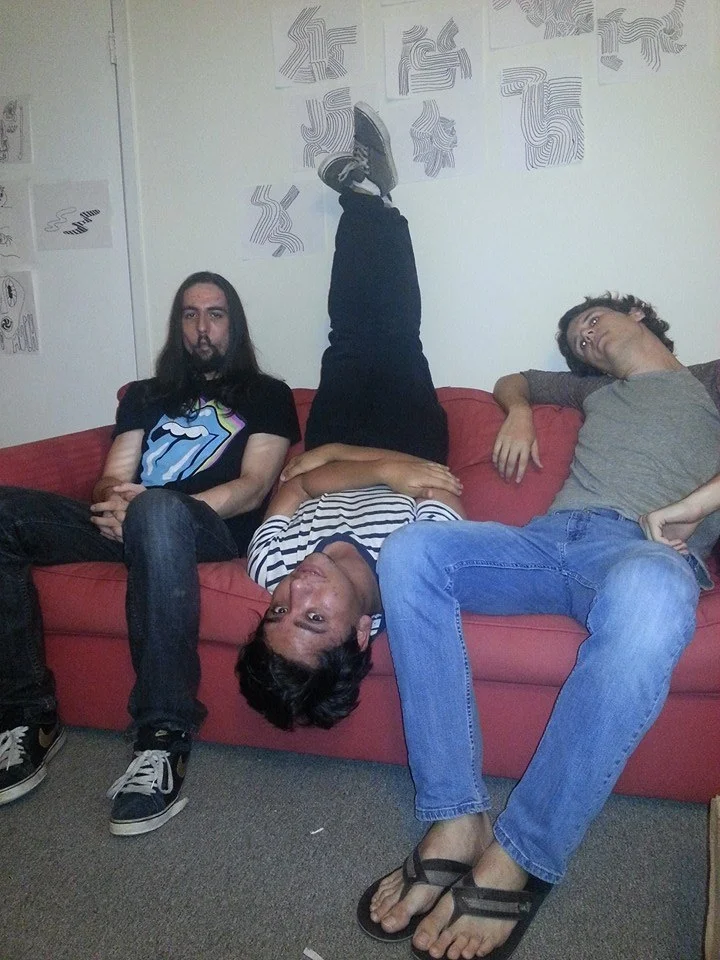
If you’ve been to Athens, Georgia lately, you’ve probably seen the name of local standouts Dead Neighbors around town, from Caledonia Lounge to Flicker Bar. The DIY trio played countless shows over the last two years before finally recording their self-titled debut, which came out on June 24th via Fall Break Records. Transverso sat down with Sebastian Marquez (vocals/guitar), Howard Stewart (Drums), and Alex Addington (bass) over some popsicles in the sticky Southern heat to talk about their beginnings, the making of the album, and the local scene. Click play, sit back, and enjoy.

Transverso: You’ve been a band for two years now and just put out your first album. How does it feel to have finally reached this landmark as artists?

Sebastian: It’s weird. It’s weird for me. Back in middle school I always thought about being in a band, then I had to switch districts in middle and high school and all the people who I thought I would’ve been in a band with, I ended up moving away from So that was interesting. The closest thing I got to being in a band back then was a talent show in high school. But yeah, it’s been really cool. It’s like I’m playing Guitar Hero, but in real life.

Howard: It’s been cool for me, not so much on the weird side, but yeah, it’s good to have records of yourself playing so you can show people. It’s nice.

Alex: I felt like we’ve been working up towards it the whole time we’ve been a band. It feels like the next logical step we needed to take to move forward as a band. 

I understand you all used to be in another band before this. What can you tell us about that?  

Sebastian: So, this is actually the origin story of dead neighbors: through sheer luck I was walking down the hallway when I lived in [University of Georgia dorm] O House on the fourth floor and I just saw two dudes playing Guitar Hero. This was at the beginning of the semester so everyone was being extra friendly, so I was like, “I love Guitar Hero!” and they were like “We love Guitar Hero!” One of the guys turned out to be Brad Gerke, and all four of us just kind of met through a series of coincidences starting with Guitar Hero. It just kind of happened.

What was that band called?

Sebastian: A Lot More Less.

How did you come up with the name Dead Neighbors?

Alex: The funeral home.

Sebastian: Oh yeah. So, when Dead Neighbors first started I was living in a house on Atlanta Avenue that was across the street from an actual funeral home. Like, I’d be sitting out on the porch reading like, Faulkner or something like that, and there would just be a funeral there. So right after we moved in the house, [my friend] came over and we were talking, and he just said randomly, “Yo, you live next to a funeral home, you should name a band that lives here The Dead Neighbors.” And I was like “drop the ‘the’ and you got a deal!”

If you weren’t called Dead Neighbors what would you be called?

Howard: I spend a lot of time coming up with ridiculously band names but I don’t know if I would want to be called any of them. One of the names my roommates and I came up with was Freudian Nip Slip.

Sebastian: I have to think about this one. Probably like, The Silver Rockets. It’s a Sonic Youth song, so…

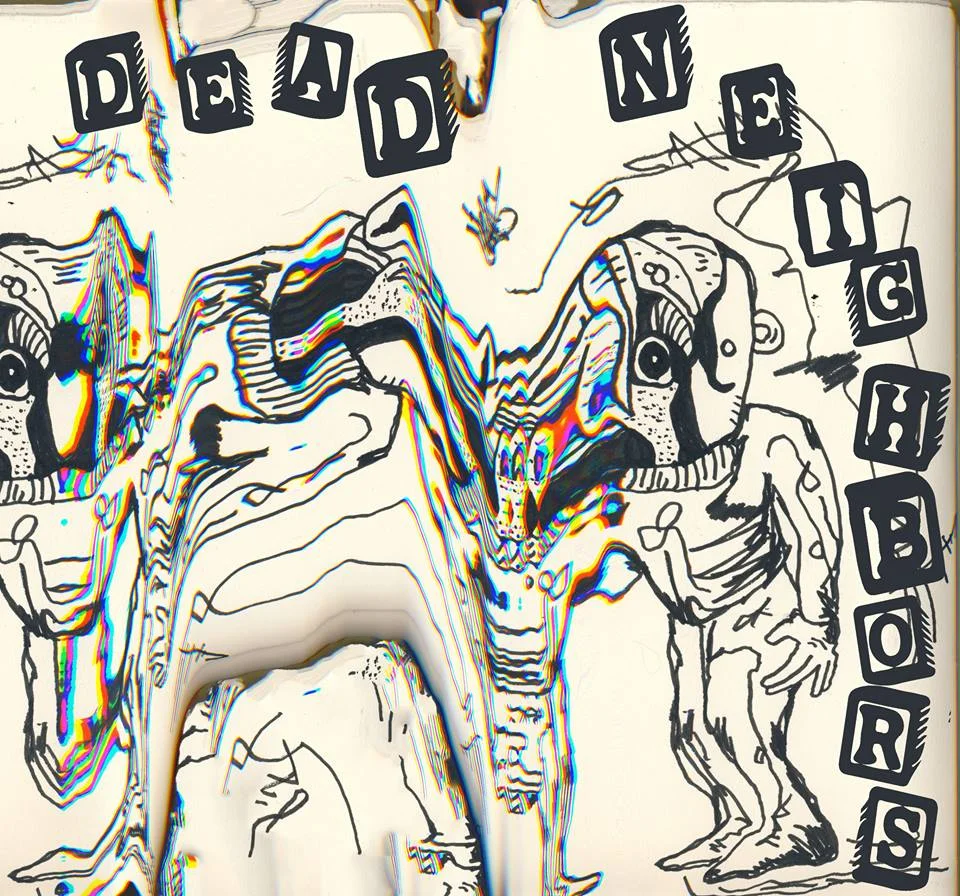
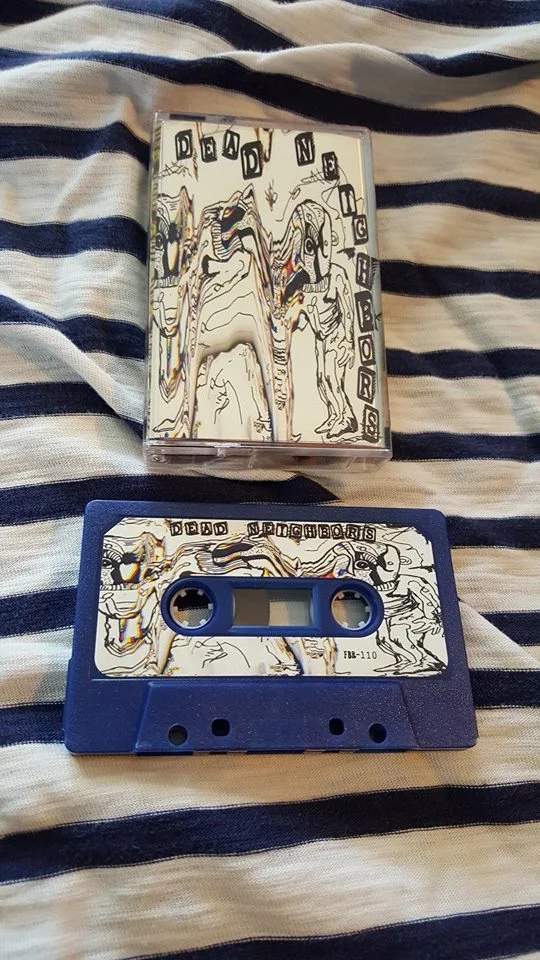
Dead Neighbors cover art, by Austin Lonsway

Dead Neighbors cover art, by Austin Lonsway

What can you tell us about the process of making Dead Neighbors?

Sebastian: We’d been playing these songs for about a year and a half at that point. I was talking to Xander [Witt] from Muuy Biien about what we could do on a budget so he pointed me towards his friend Scott, who used to live at the [creative space] Secret Squirrel. He’s up in New York now. We just recorded the whole thing in his bedroom in the basement of the Secret Squirrel, which is beneath Ben’s Bikes. It was cool. [It was over] a period of about like a month or so?

Howard: Yeah it was like February.

Sebastian: Yeah, just over the course of that month we would just go over there on weekends, I would just drink a shit-ton of tea and either do guitar takes or vocal takes. Howard was able to get all of the drum takes out in one day. There was minimal confusion honestly. All things considered it went really smoothly considering our budget of nothing. It was really cool. So we recorded the whole thing for about a month, we sat in a listened to some mixes and I just gave him some notes on it and then we had the first copy of the album ready within a week after that. I sent it over to Terence [Chiyezhan], you know, murk daddy flex, [and] he mastered that first copy. But that mastering brought out some things I didn’t like about the album, like vocals too loud on Stereo Song or the guitar not sounding right on Ever or something like that. By that point, Scott had already moved to New York so it was emails back and fourth for about another month, giving him notes, trading music back and forth. After that was done, I brought the album over to Terence and we mastered the album in one day. We just sat in his bedroom and we mastered it using his monitors and his computer. I know enough about studio work to be dangerous enough but for the most part he was like “just close your eyes and tell me when you think there is enough reverb.” It was actually really easy and very fast. We knocked the whole thing out in about four hours. On a side note he had some of the best tea I’ve ever had.

What was it like recording in a bedroom?

Sebastian: Cozy. It was a cool bedroom so that helped psych me up for it.

Howard: It sounded pretty good. I don’t know a lot about sound but Scott told me it was a good room to record drums in, it was like L-shaped.

Sebastian: It was very asymmetrical.

Howard: So the drums sounded good. It was a very relaxed thing. I feel like in a studio there would be a lot more pressure to get stuff done as soon as possible.

Sebastian: The vibe felt good.

What would you say is the overall mood of the album, what it felt like when recording?

Sebastian: So, have you ever watched Neon Genesis Evangelion? It felt like that!

Howard: I’ve never watched that.

Sebastian: It’s an anime. But you know, it felt surreal for me. Just doing exactly what I wanted to do. Getting to play guitar really loud and sing into a microphone for money. It was cool.

Howard: The mood of the album itself, there are some more angry songs on there, but I think as we progress we get a bit more chilled out.

Alex: I’ve done my own stuff when I’ve recorded myself a long time ago, but it felt pretty natural. It was exciting to record all of the music we’ve been working on and playing at shows.

What equipment do you use that affects your sound most?

Sebastian: The combination between guitar and amplifier always has a weigh in on it. The guitar I was using was the very first electric guitar I owned. My dad got it for me for like, an eighth grade birthday present. It was a really crappy guitar, but it could still play and I think that guitar specifically had a greater effect on the way the album sounded, pedals notwithstanding

Alex: Sebastian doesn’t really use pedals all that much, and I don’t use them at all. I really just mess with equalizers a lot on the amps. 

The album is a sort of mixture between shoegaze and punk. Do you identify with one more than the other?

Sebastian: I feel like I listen to more shoegaze. I started discovering punk the summer after A Lot More Less ended up disintegrating and it heavily informed me when I was writing the album. Bands like Mission of Burma and Sonic Youth. Sonic Youth isn’t necessarily punk, but they do have their punkier moments.  It’s kind of hard to put Dead Neighbors in a box but I end up saying, for the sake of ease, that we split the different between Mission of Burma and My Bloody Valentine. I guess myself, I identify with the shoegazer archetype if there is one.

Howard: I’d say for drumming, I’ve always played punk rock beats on the drunk set. So I guess the default, go-to drum parts that I wrote, especially for the first songs, were a lot more punk influenced for sure.

Fall Break Records is distributing the album as cassettes. How do you feel about that particular format and are there plans to release it in others?  

Sebastian: I feel like a cassette is the best way to listen to the album honestly. There is just that layer of hiss that adds something else to music. And I think specifically what we’re playing is going to sound really good on it. We don’t have any plans to release it on any other format right now. For most of our shows, what we’ve been doing right now is just burning CDRs in my room and having people pay what they want. Technically its out on CDs but only if you come to our shows. [Dead Neighbors is available on cassette and digital format here, as well as on iTunes here.]

What is your favorite song off the album?

Sebastian: That’s a tough question. It’s probably “Tell” because it’s got both sides, it has both of the moods that we explore on the album in one song. That and it’s just really fun to play. The transition part with all the snare drum hits and all the harmonics on the guitar part is really cool. It’s the most fun to play for me.

Howard: Yeah I like “Tell.” I think it’s my favorite because the song was written very well. It has the light airy part in the beginning and then hits you in the face.

Alex: I would probably say, I like “Stereo Song,” but Tell is probably a close second. It’s either or.

 What is the song you hate most in this world?

 Sebastian: You know, for a while it was actually “Hey QT” but I’ve done a complete 180 since because I fucking love PC Music.

Howard: There are a lot of songs that I’ve heard that I just think are terrible and I would want to do most things other than listening to them, but I don’t know the names of them or who it’s by.

Alex: This is specific and it’s not like they wrote the song but I just recently heard Guns N’ Roses cover of “Knocking on Heavens Door” and that would have to be one of them to be honest. Or anything written by Nickleback.

What is a lyric you’ve misheard in the past?

Sebastian: This happens to me a lot. I was reading the lyrics to “Zebra” by Beach House and for the most part I just didn’t understand anything Victoria Legrand was saying at all. I looked at the lyrics, they’re actually really pretty. I always thought the song was explicitly about Zebras but now that I’ve read the lyrics I have no idea.

Howard: Recently I listened to a Smashing Pumpkins song called “Lucky 13” and I swore that he said something about Obama in the chorus. They I looked it up and the song was released in 2001.

Alex: 75% of what Nirvana preforms. And in studio too.

What does it mean to you to be in an artist in Athens, Georgia?

Sebastian: It feels really cool to me. With the album now, I feel like we just kept this really cool tradition going, kind of like the passing of a torch. Right now we are just a little scribble in a really big book but I think it’s pretty cool to be a part of a scene that is bigger than yourself.

What are some of your favorite local bands?

Sebastian: Always much love to Muuy Biien. RIP Nurture. Lets see, if we’re talking Athens and Atlanta I love Warehouse so much. We’ve been super tight with Swamp since day one.

Howard: Yeah, I like Swamp. And in Atlanta I like the band Sling.

Sebastian: Shouts out to Saline too.

What is your favorite venue to play?  

Sebastian: I love playing Flicker. The sound guys are cool, you get two free beers, and I like how it looks and the way the stage is set up. They have some weird stuffed birds above the stage and some flags. My favorite addition is if you’re on the stage and looking directly forward and then up there’s a big black light poster that just says “Don’t Fuck Up.”

Howard: Flicker is my favorite as well. If you get like 15-20 people there, even that amount of people it feels like it’s full.

Alex: I think my favorite to play would be the 40 Watt but in terms of places we regularly play at I would say Flicker also.

What other cities would you like to play most, and which bands would you most like to tour with?  

Sebastian: I want to play in New York, Berlin, and Tokyo and I want to tour with Deerhoof. On a slightly more realistic note, we’ve had multiple bands from Boston and Philadelphia play with us and they’ve always been really receptive to it. So I think playing there would be really fun. Also on a more realistic note, I would like to tour with Scooterbabe.

Howard: I’d like to play in Chicago maybe, or like San Francisco or London.

Alex: In terms of a venue I think it would be cool to play Royal Albert Hall or something like that. 

Why should people care about what you’re doing?

Sebastian: Well, I can’t tell people to care about it, but it’s really earnest I think. We didn’t make this band because we wanted to make money, we’re doing it because we want to make music and it really comes through on the album. I think people should care because it’s such an earnest offering of music. It’d be really cool if everyone listened to it.

What’s next for Dead Neighbors?

Sebastian: Even while we were recording the album I was working on new material. We have two new songs that weren’t on the album that we’ve been playing live for a few months now. I’m working on writing words for a third song so I was thinking we get like, two more and I make some ambient stuff and we could have a good EP on our hands.


Dead Neighbors is out now on Fall Break Records, and you can buy it in cassette and digital formats here, as well as on iTunes here.

'Music For Dogs' is Gardens & Villa's Transitional Catharsis

Music ReviewWeston PaganoComment

Despite its name, in Music For Dogs you won’t find high pitched whistles only canines can hear. As far as we know, at least.

Gone too are the tightly controlled and driven, pulsing melodies of 2014’s brilliant and powerful Dunes. The delightfully wild erraticism and uniqueness of its flute and many of the delightfully shocking falsettos are absent as well. Gardens & Villa, now a duo, have moved away from the alternating Tim Goldsworthy-produced dance pop hooks and synth-soothing minimalism to return to their roots, yet their retreat seems haphazard at times. While before their high energy tracks exuded a sort of sexy confidence, the more frantic tracks on Music For Dogs feel as if they’re being chased by their own ambitions, looking over their own shoulder all the while. 

After a bubblingly synthetic "Intro" catapults you into "Maximize Results" you’re whisked into vocalist Chris Lynch forcefully inviting “Looking for love I can take you there / Pushing my luck I can take you there,” seemingly embarking on something promising as his voice rises in pitch to a piercingly frenetic crescendo over quickly hammered keys.

The following track, leading single and pop highlight "Fixations," is an interesting anomaly in the way that it eschews both Dunes' inspired, hard-hitting drama and Music For Dogs' chaos with a much looser and more playful vibe, especially echoed by the video reminiscent of the Warhol-esque psychedelic party scene in Midnight Cowboy. Acting as the middle portion of a one-two-three punch with "Everybody" marching in at the rear, we begin to hear the paranoia implicit throughout much of the record vocalized: “Everybody wants the new you / Nobody cares who you are / Taking pictures of the new you / Watching you from afar / Everybody wants to use you." This sort of discontent commentary on a paparazzo-style culture of music consumption and the fickleness of an industry in which they recently experienced rejection from both their label and disillusioned significant others, it conceives an idea that one would anticipate going on to form the backbone of the LP, but strangely seems to peter out.

The momentum slows after this, as Gardens & Villa mix in the introspective self-help mantras of "Paradise"’s “I wanna believe that I’m trying everything / It could be me someday / I’m gonna find my paradise” with the more literally grounded “Alone In The City,” in which the band, having recently relocated to LA, deliver some of the record's most rousing vocals as Lynch cries out “Do you feel alright?” It's genuine soul-searching, though it's clear the duo might feel more comfortable in their own skin if they could just pin down exactly where it is.

Bookended by “General Research”’s brief resurgence of the iconic flute of old (this was the first time I've ever listened to an album and thought “Wow, I wish this had more flute”) and the monotonous “Jubilee” cleverly mentioning our “terminal verbosity” slogan within the din, is standout track “Express.” And it indeed feels like an express, opening with drum set locomotion like its brother “Bullet Train” (from Dunes) before passing straight by any unnecessary stops. “Express" propels us back to the suaveness we love Gardens & Villa for best, complete with punchy guitar and Lynch articulating that it’s “time comes to express your feelings” while his haunting vocal specters do just that even better than words. 

It's hard to put your finger on exactly why Music For Dogs feels like a step back despite these bright moments. “I wanna believe that I’m trying everything” Lynch croons, and though some of the glittering texture and synth soundscapes are there, they now feel like the exception instead of the rule, having taken a backseat to more traditional measures. You can’t help but wonder if the short 36 minute runtime feels a bit rushed because it was, with the album being written and recorded so shortly after their previous full length and the subsequent Richard Swift-aided Televisor EP (which, by the way, is too often overlooked). 

We only eventually catch a glimpse of the lingering regrets of the duo’s two ended relationships at the very end in "I Already Do,” a melancholic yet optimistic sign off. Suddenly the LP feels like it only narrowly missed being a breakup album, with “I still never deleted all my photos of you / Keep them in my pocket but I’m never scrolling through” firmly dating the record in 2015. Lynch’s declaration of “It’s so hard to breathe when you’re always on the move” speaks volumes about where their transitions in sound, location, and romance have left them, yet there’s little resolution: in cathartically lilting "I’m gonna miss everyone / I think I already do” he leaves it unclear whether Music For Dogs is a beginning or an end.

'The Man From U.N.C.L.E.' Is Sleek Spy Fun

TV/Film ReviewEthan WilliamsComment

Set during the chic, sleek Sixties at the height of the Cold War, The Man from U.N.C.L.E. marks the first return of indie-British-turned-Hollywood director Guy Ritchie since his big budget adaptation of the Sherlock Holmes franchise. Based on the 1960s television series of the same name, U.N.C.L.E. follows American secret agent Napoleon Solo (Man of Steel’s Henry Cavill) and his Russian counterpart Ilya Kuryakin (The Social Network’s Armie Hammer) as they have to put aside their countries’ differences to protect the lovely Gabby Teller (Ex Machina’s Alicia Vikander) and try to find her missing father who may be hiding nuclear secrets key to both sides of the Cold War.
 
            Combining three of the hottest tickets in Hollywood at the moment in its three lead roles, The Man from U.N.C.L.E. is a whizz-fizz of a spy thriller, disappearing in a puff of smoke almost as soon as it enters your brain. It’s a rush of beautiful people in beautiful locations with plenty of charm to spare, even if there isn’t an entirely substantive reason for the whole shebang. And while all three leads acquit themselves quite admirably, trading quips and barbs with ease, the film really shines when its focus turns on the rapport of Cavill and Hammer, with Cavill being U.N.C.L.E.’s true standout. The brilliantly cheeky homoerotcism of the whole affair is a nice little play on the buddy cop formula, and I have to admit, the film does get a lot more fun when you imagine Cavill and Hammer are in fact in love with each other.

While the set pieces feel relatively smaller in scale compared to most summer blockbuster fare, the fun lies more in how Ritchie infuses them with his trademark sense of black humor and just enjoying the rapport that is built between Cavill and Hammer.  Whether it’s the tables turning on the Nazi torture scientist or the delightful boat sequence where Cavill decides to have some lunch, the small scale is overcome by the unique execution.
 
As an adaptation of a Sixties spy television series, The Man from U.N.C.L.E. succeeds in translating that kind of tone and charm into big screen laughs and thrills, even if it never reaches the dizzying heights that made a series like Mission: Impossible certified box-office gold. That being said, it's easy to tell that in less playful hands this material could’ve scraped the bottom of the Bond barrel, but luckily coasts by on the merit of snappy one-liners and a sexy cast instead.

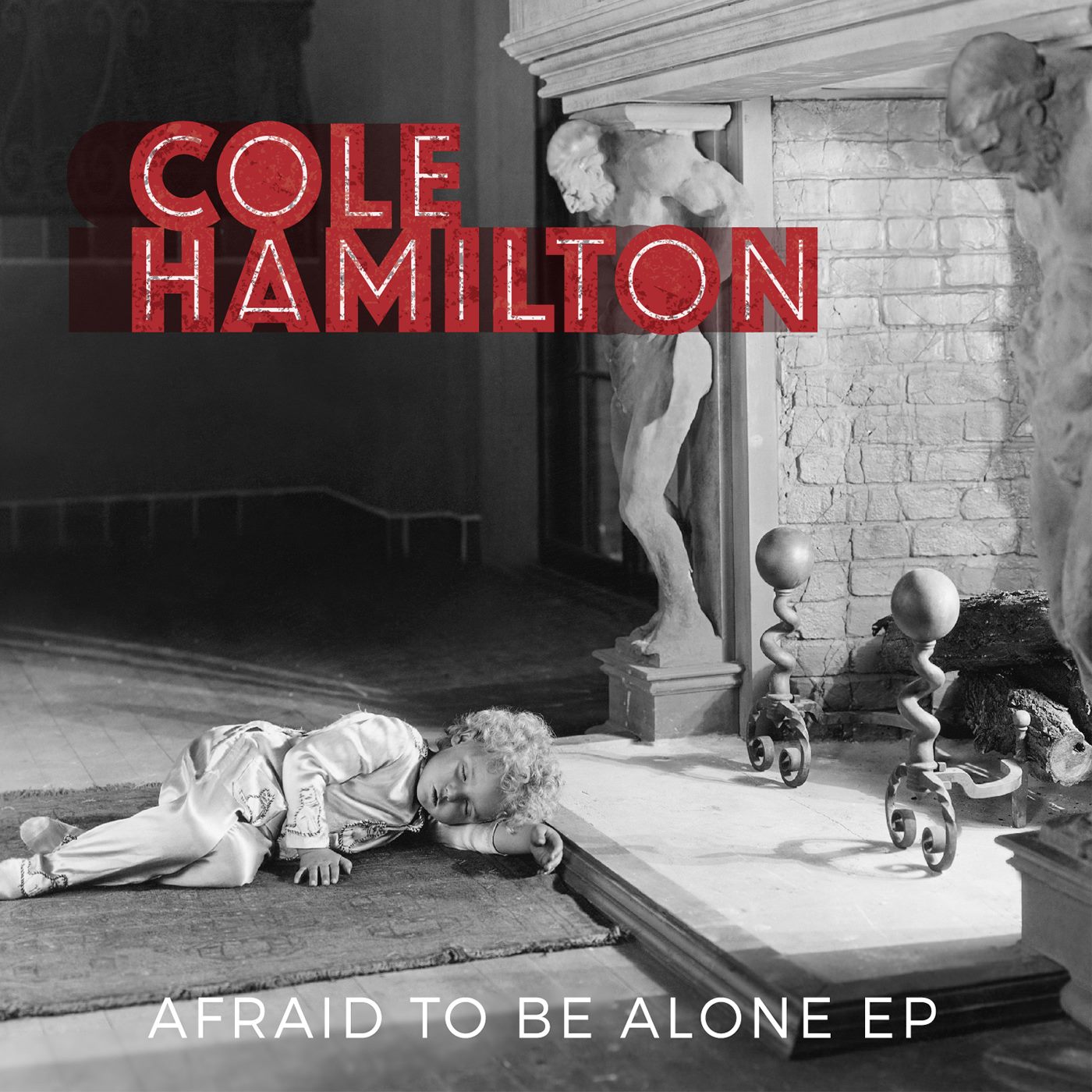
EXCLUSIVE PREMIERE: Stream Cole Hamilton's Debut EP 'Afraid To Be Alone'

Exclusive Premiere, New Music, Music NewsEllen WilsonComment

It’s hard to believe rising Tulane University sophomore Cole Hamilton didn’t begin writing music until his first year of college. It’s not that that’s too late in life, it’s just surprising considering the amount and quality of work he has already completed in such a short time when most of us were still trying to figure out which building our classes were in.

“I spent the whole year writing music and ended up with 20-plus songs,” Hamilton told us.  “From those 20 I took my favorite four and made the [Afraid To Be Alone] EP.” 

Hamilton recorded these tracks after returning to his hometown of Northbrook, IL where he reunited with high school friends Chris Neuhaus (drums), Paul Tisch (bass), Gracie Sands (guitar), Peter Roberson (trombone), Danny Neuson (trumpet), and Joseph Lee (saxophone) and worked with producer Craig Williams at Dr. Caw studios.

Afraid To Be Alone begins with catchy Two Door Cinema Club-inspired pop-rock tracks “(Just Between) Everyone You Know and Me” and "Louisiana" before descending into darker vocals evoking an Arctic Monkeys-esque swagger in “Crystal.” The EP ends with “Stay/Go,” a track adorned with a heavy horn section and an earnestness that will leave you wishing Hamilton would indeed stay instead of go. 

Afraid To Be Alone is out now and available on Spotify, which you can listen to below.


Life's a (Dirty) Beach in Beirut's New "Gibraltar" Music Video

New MusicWeston PaganoComment

Beirut have followed up the peculiar and playful music video for their forthcoming record No No No's title track with "Gibraltar," a slow, percussive number showcasing vocals from frontman Zach Condon as gentle as lazy waves on the beach.

It seems fitting, then, that the new music video accompanying the single has the band ambling across that very landscape, though in this case it is littered with trash. Surreality and smoothness are not the only traits the two videos have in common, though, with this one also being the directing work of Brother Willis.

Watch "Gibraltar" below.

No No No can be yours this September 11th via 4AD.

Tame Impala's New "Let It Happen" Music Video is Hallucinatory Hell

New MusicWeston PaganoComment

Tame Impala's recent record Currents is a stand-out so far this year, so it's only fitting that the music video for the opening track "Let It Happen" should be equally impressive.

Directed by Grammy-nominated filmmaker David Wilson (who also directed the band's Lonerism single "Mind Mischief" back in 2012), the video shows a hallucinatory and "An Occurrence At Owl Creek Bridge"-esque journey through skies of nightmares for the hapless protagonist.

Unfortunately (though understandably), the 7:49 minute track is cut down to 4:16 for the video, though the original length is cleverly displayed on the alarm clock featured at the 1:14 mark.

You can check it out below, but with a viewing experience this exhilarating you may want to be buckled in thrice like the character himself.

'Paper Towns' Doesn't Quite Live up to What John Green Had Mapped Out

TV/Film ReviewWhitney WilliamsComment

When Paper Towns came out many people flocked to the theaters with a pack of tissues in hand expecting to see a movie similar to The Fault in Our Stars, but this film is not a tear-jerking teenage melodrama quite like Green’s previous work. Behind the plot of a missing girl and a boy’s determination to find her is a genuine true-to-life story about a group of kids who don’t have it all figured out, but they sure as hell are trying. After selling millions of copies, the novel debuted as #5 on The New York Times Bestsellers List. But did the film reach its full potential?

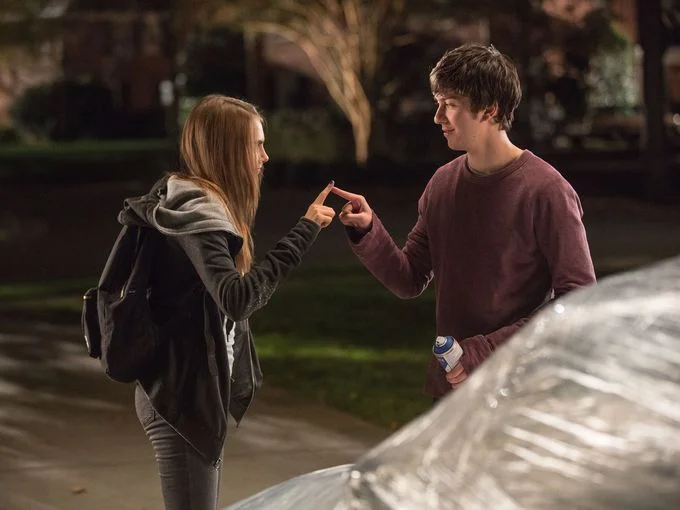
A paper town is not a real place but rather a nonexistent location put on a map by its creator to protect against copyright infringement – if the town is found on another map they would know it was copied. In the author’s note of the novel John Green says it is the idea of “creating something that other people want to make real,” which largely sums up leading (though absent for most of the film) lady Margo Roth Spiegelman’s driving force of motivation in life. Margo (played by model and St. Vincent’s girlfriend, Cara Delevingne) is the It-Girl at Jefferson High School, with a hundred stories winding the rumor mill about her many adventures on the East Coast. As well as being the most popular girl at school, she also lives across the street from awkward and straight-edged Quentin (Nat Wolff), the film's leading man. Quentin’s initial monologue explains the many miracles of life and his belief that everyone is entitled to at least one of these miracles during their lifetime. Endearingly, Quentin considers living near Margo to be his.

The two were childhood friends before their lives took different paths and drifted away from each other, so when Margo crawls through his bedroom window a few weeks before graduation and convinces him to join her for a night of revenge, he can hardly refuse her persistent charms. She persuades him to perform epic pranks including vandalism and breaking and entering – basically the most eventful night young Quentin has ever had. “That’s the way you should feel your whole life!” Margo lectures Quentin.  His head spinning with excitement, he goes to bed unaware that his childhood crush would go missing the very next day, gone to exile herself in an attempt to make her very own paper town real. 

Aided with the clues Margo left behind, he sets out on an cross-country adventure with his best friends, Ben (Austin Abrams) and Radar (Justice Smith), traveling 1200-miles to upstate new york to find Margo and her new, fictional place of residence, risking the possibility of missing prom.

Prom? What started out as a promising tale of self-discovery disappointed me when they made the stakes so mundanely low, ultimately condemning Paper Towns to be a typical teen flick. It contains all the elements of an average teen movie: Kids sneaking out, cool kids conspiring with nerds, a complete lack of adult supervision, a wild party, and, of course, a Senior Prom in jeopardy. With the only real risk being the possibility of missing prom as opposed to graduation itself as it was in the original text, screenplay adaptors Scott Neustadter and Michael H. Weber did not give Paper Towns much room to grow. 

Another example of exaggerated low-stakes is the overly dramatic scene during the road trip at the gas station. With only six minutes to fill the car with gas, buy some food and grab a change of clothes, the trio of teens, now joined by Radar’s girlfriend Angela (Jaz Sinclair) and Margo’s best friend Lacey (Halston Sage), sprint out the convenience store and pile into the car with Quentin doing a cute little spin over the hood. I understand the need to represent a time crunch, but the scene comes off as being overemphasized.

Though not solely the fault of Shreier who does try to take advantage of slower scenes in between for character development, the cast still feels paper-thin. Quentin starts out as a work-obsessed geek who is loyal to rules and restrictions and ends the movie with hope for the future, marveling in the revelation that Margo was never more than a girl (“What a treacherous thing it is to believe a person is more than a person”). This is a revelation he would not have come to terms with if not for Manic Pixie Dream Girl, Margo Roth Spiegelman. 

According to film critic Nathan Rabin, a Manic Pixie Dream Girl (MPDG) is a cute and quirky, female romantic lead  “that exists solely in the fevered imaginations of sensitive writer-directors to teach broodingly soulful young men to embrace life and its infinite mysteries and adventures.” Here lies the neat and tidy description of Margo’s role in Paper Towns. The problem with characters like Margo is that she only exists as a means to aid the young white male on his own road to discovery.  Paper Towns’ story arc inched along until it eventually dropped off at the discovery of Margo, and seeing as we never find out what she intends to do with her life (let alone where she lives), one can’t help but feel the filmmakers simply used the trope of a confused young girl as an easy plot-device. But hey, as Margo said, “Everything is uglier up close.”

One can appreciate Paper Towns with nostalgia for high school days, but with that being said, I would have enjoyed the film a lot more if I was still fifteen years old. By leaving out so much of the novel, Shreier’s adaptation failed to fully realize the inspiring, coming-of-age story John Green had mapped out.

No, Tall People Are Not Obligated to Stand in the Back of the Crowd

EditorialWeston PaganoComment
iStockphoto.com

iStockphoto.com

As part of a series called The Good Listener, NPR recently ran a piece titled “Are Tall People Obligated To Stand In The Back At Concerts?” in response to a Facebook post by an individual (presumably of the shorter variety) who complained:

I was recently at a show of the unseated variety when, to my dismay, a very tall and wide chap with a head boasting the approximate dimensions of a cereal box stationed himself directly in front of me. I spent the whole (crowded) show craning to one side or another so that my view was not entirely obstructed. I wished this gentleman to be banned from concert-going forever, or at least to be forced to view the show from the back row of every venue. My question is: What obligation does the big/tall person have to his or her fellow concertgoers with regard to obstructing the view?

Cranium sizes comparable to breakfast food containers aside, tall people are not a rare species at musical performances and other cultural events in which many people are gathered together to look in one direction and view a single stage. Many of these concerts are general admission, meaning that the floor is open to standing room exclusively, and that space is filled on a first-come first-serve basis, regardless of physical stature. And that’s that.

The idea that everyone should be able to have equal and unobstructed lines of sight towards the front of the venue is a nice one, though ultimately utopian. While a short concert-goer wishing to relegate a fellow fan and peer to the back of the bus so-to-speak (or worse, have them “banned from concert-going forever") for a better view based on a characteristic they cannot control is at best idealistic, it’s at worst incredibly self-entitled and unfair. Shows aren’t an inherently oppressive economic system you need to right with compensatory measures; you do realize you can just show up earlier and wait in line like the rest of us, right?

I am about 6’4” and I enjoy being close to if not in the front row. I have been known to arrive to the venue long in advance to secure such a position. Anyone who does that earns their proximity to the action, and anyone who waltzes through the crowd halfway through the first song, feeling as if they deserve to be ahead of you because they never grew out of their high school height, does not. The only thing they should be at the front of is a list of the worst people ever.

I’m not trying to pass this generalization off as fact, it’s merely been my experience (and of course there are plenty of exceptions), but concert-goers of a smaller stature are almost always the most intolerably inconsiderate individuals in the crowd. Whether they are shoving themselves in between and in front of my friends and I, blowing smoke up into my face, repeatedly fist-pumping into my nose, standing directly on my feet for an extra lift for an extended period of time (when I asked her to move she pretended as if she hadn’t noticed she was literally climbing on top of my body), or even just subtly trying to make me feel guilty the entire time, the sense of cavalier entitlement coupled with a raging Napoleon complex is far more obstructive to one’s enjoyment of a night out than an eager fan who simply has to wear a longer size of pants.

And most of the time, short people do better in life than we do anyway: they fit in car and plane seats more comfortably, they can find clothes that fit them without much effort, and they're even likely to live longer than us. My head never even makes it in photos. Let us have this one.

"Don’t you have a heart?” you may be asking. “Why do you hate short people? They can’t help it!”

Well, yeah. If you’re nice to me I’ll probably just let you in front of me anyway by choice. Specifically, if you’re the adorable elderly woman who came to see Paul McCartney at Lollapalooza a couple of weeks ago, I was more than happy to hold your sign for you and help you get closer to our hero.

Everyone else? Come wait in line with me from the beginning, we'll stand together.